How Different Grit Sizes of Diamond Powder Affect Processing Efficiency
Diamond powder is a versatile and essential abrasive used in various industries for precision grinding, polishing, and lapping. Its performance greatly depends on the particle size, ranging from coarse micron sizes to fine nanometer particles. This article explores how different grit sizes of diamond powder impact material removal rates, surface smoothness, and machining precision. Understanding the appropriate selection of grit sizes for specific applications can lead to improved efficiency, reduced processing time, and superior surface quality.
10/10/20252 min read
What is Diamond Powder Grit Size?
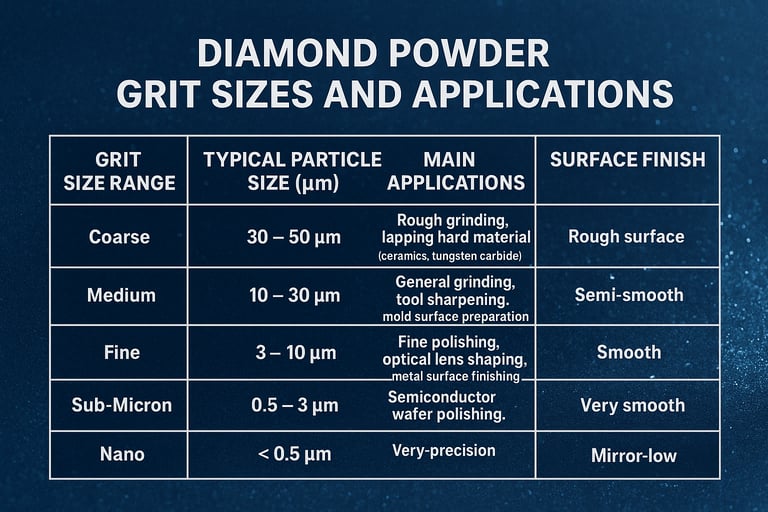
Diamond powder is available in a range of grit sizes, from coarse particles (30–50 microns) to ultra-fine particles (sub-micron to nanometer scale). Grit size refers to the particle size distribution, and it plays a crucial role in determining the effectiveness of the diamond powder for specific applications. The smaller the grit size, the finer the finish, but with a slower material removal rate. Conversely, larger grit sizes are suitable for rougher, faster material removal, but they can leave a more uneven surface.
Impact of Coarse Diamond Powder on Material Removal
Coarse diamond powder, typically in the range of 30–50 microns, is primarily used in rough grinding and material removal applications. It is ideal for processing hard materials such as ceramics, carbide, and granite, where high removal rates are needed. However, the trade-off is that it may not provide the desired surface smoothness, and additional polishing may be required.
The Role of Fine and Sub-Micron Diamond Powder
Fine and sub-micron diamond powders, typically ranging from 1 to 10 microns, are used for precision polishing and fine grinding. These powders are suitable for applications requiring smooth surfaces, such as optical components, semiconductor wafers, and jewelry. The small particle size allows for the removal of minor surface imperfections while providing a high degree of precision and surface reflectivity. The slower material removal rate can lead to longer processing times, but the result is a mirror-like finish with minimal roughness.
Ultra-Fine Nanometer Diamond Powder for High-Precision Applications
Nanometer-grade diamond powder, with particle sizes below 1 micron, is ideal for ultra-precision polishing in high-tech industries. It is often used for applications such as semiconductor wafer CMP (Chemical Mechanical Polishing), optical lens polishing, and high-end jewelry finishing. The extremely small particle size enables atomic-level smoothness, making it essential for achieving the highest quality surface finishes without compromising precision.
Selecting the Right Grit Size for Your Application
Choosing the correct grit size is crucial for achieving optimal performance in diamond powder applications. For rough grinding and high material removal rates, coarse diamond powders (30–50 microns) are ideal. For fine polishing and achieving high surface quality, fine or sub-micron diamond powders (1–10 microns) are preferred. Nanometer diamond powders are used when the highest precision and surface smoothness are required. Selecting the right grit size will not only improve processing efficiency but also reduce the overall costs by minimizing the need for additional polishing steps.
Conclusion
The grit size of diamond powder plays a pivotal role in determining the success of any grinding, polishing, or lapping process. Coarse powders provide fast material removal, but they may not offer a fine finish. Fine, sub-micron, and nanometer powders are essential for high-precision applications, offering smooth, mirror-like surfaces. By selecting the right grit size for specific tasks, manufacturers can achieve optimal performance, reduce processing times, and enhance the quality of the finished product.
Get in touch for inquiries about diamond powders and expert guidance.