
Using Diamond Powders in Optical Component Manufacturing
Diamond powders are widely used in the manufacturing and finishing of optical components due to their extreme hardness, consistent particle size, and ability to achieve nanometer-level surface finishes. From glass lenses to laser mirrors and infrared windows, the precision and clarity of optical components rely heavily on the quality of abrasive materials. This article explores how diamond powders are used across different stages of optical production and why they remain the top choice for high-end polishing applications.
10/13/20252 min read
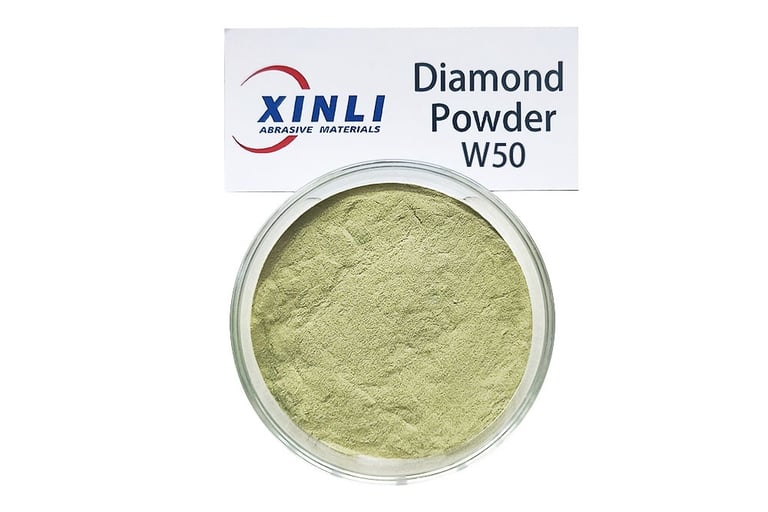
Introduction: Why Optical Manufacturing Requires Ultra-Fine Abrasives
Optical component manufacturing demands extreme precision. Even a surface irregularity of just a few nanometers can distort light transmission or reflection. Traditional abrasives like alumina or ceria often fail to meet such precision, especially for hard materials like sapphire or fused silica. Diamond powder, with its unparalleled hardness (10 on the Mohs scale) and controllable particle morphology, enables the ultra-smooth finishes required for optical clarity.
Key Roles of Diamond Powder in Optical Processing
In optical manufacturing, diamond powders are used across multiple processing stages.
During rough lapping, coarse diamond particles ranging from 15 to 30 microns are employed to remove large surface defects and shape the substrate efficiently. This stage focuses on material removal and initial form accuracy.
Next comes fine grinding, where medium-to-fine diamond powder (typically 3 to 10 microns) is used to refine the surface, enhance flatness, and reduce subsurface damage. This step prepares the component for precision polishing.
Finally, polishing uses ultra-fine or submicron diamond powders (0.1 to 3 microns) to achieve optical-grade smoothness. At this stage, the surface roughness (Ra) can be reduced to below 1 nanometer, resulting in a flawless mirror-like finish suitable for high-end optical devices.
Materials Commonly Polished with Diamond Powders
Diamond powders are compatible with nearly all optical substrate materials. They are widely used on fused silica, BK7 optical glass, sapphire, YAG and YVO₄ crystals, silicon and germanium wafers, and even infrared optical materials such as ZnSe and CaF₂.
These materials form the backbone of modern optical technology, appearing in products like lasers, high-precision imaging lenses, infrared systems, and aerospace optics.
Advantages Over Traditional Polishing Materials
Compared to conventional abrasives such as cerium oxide or aluminum oxide, diamond powders provide distinct advantages. They offer faster material removal rates, particularly on hard substrates, while maintaining superior surface finishes with roughness below 1 nanometer.
Additionally, diamond’s inherent hardness ensures longer tool life and better heat control due to even slurry dispersion during polishing. These factors make diamond powder not just an abrasive, but a performance-critical material in the precision optics industry.
Conclusion
Diamond powder continues to define the standards of precision in optical component manufacturing. Its ability to balance efficient material removal with atomic-level smoothness makes it indispensable — from smartphone lenses to aerospace-grade optics, it is the invisible force behind optical perfection.
Get in touch for inquiries about diamond powders and expert guidance.